



Case Vignette
A 69-year-old male farmer ,without any prior known comorbidities, presented with acute low-back pain progressing to bilateral lower- and upper-limb weakness over 6 days. It was preceded by easy fatigability, sore throat and dry cough.This followed a 2-day high-grade febrile illness with chills. He also complained of abdominal pain and shortness of breath (SpO₂ 88% on RA → 96% on 4 L O₂). Physical examination revealed mild pallor with pitting edema in bilateral lower limbs . Tenderness was present on palpation over axillary and lower limb muscles . MMT-8 (Manual Muscle Testing) score was 68/140 suggestive of significant muscle weakness .
Laboratory investigations revealed:
Hemoglobin: 10.2 g/dL,TLC: 17800/ cumm, Platelets: 53,000/cumm
CPK-NAC :1034 U/L and LDH: 634 U/L
SGOT: 170 U/L and SGPT: 30 U/L
S.Creatinine : 1.93 mg/dL
Urine color was dark brown for initial 3 days (improved with adequate hydration)
However, MRI of the thighs revealed multiple intramuscular abscesses.(Figure1).
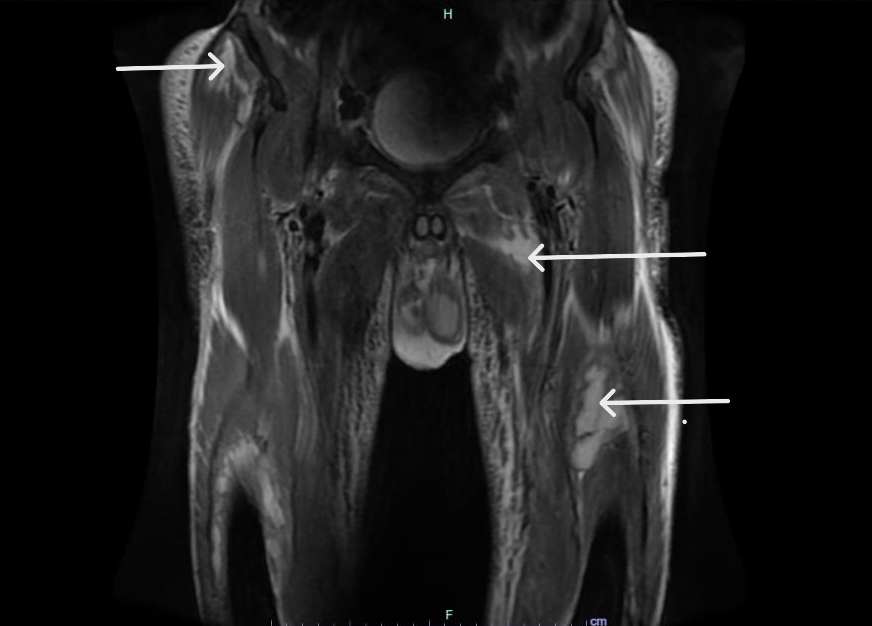 Figure 1: T2/STIR MRI (Coronal section) Arrows showing multiple hyperintense intramuscular collections within thigh muscles suggestive of pyomyositis
Blood culture grew MSSA (Methicillin Sensitive Staphylococcus aureus) along with pus culture which was also positive for MSSA with similar antibiotic sensitivity pattern
Q. Which of the following statements BEST explains the pathogenesis and diagnostic challenges in this patient?
A. Viral myositis directly progresses to pyomyositis without bacterial invasion
B. A pathobiome emerges when commensal organisms become invasive due to altered host immunity after viral illness
C. Streptococcus species are the predominant pathogens in community-acquired pyomyositis
D. Early empirical antibiotics increase diagnostic yield by sterilising deep abscesses while preserving blood cultures
ANSWER: The answer will be released in the December 2026 issue.